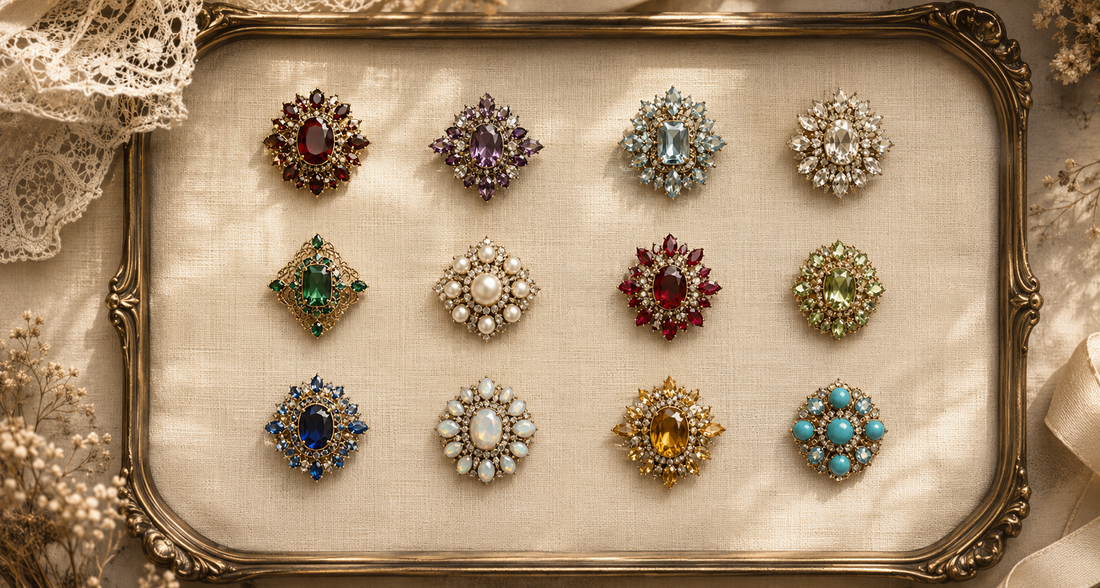
Find Your Colors: A Birthstone Color Guide
A Color for Every Birth Month
Long before birthstones appeared in jewelry catalogs, they were worn as a quiet language. A single color, set close to the body, could say where you came from and who you belonged to. That idea is older than any shop, and it is the idea Veyamoon is built on. Our hero tool, Find Your Colors, begins with a birthday and ends with a palette: your birthstone, your zodiac element, and the brooch colors that speak for you. This guide is the long-form companion to that tool. We walk all twelve months, naming each stone, its signature color, the feeling that color carries, and one practical note on how to wear it.
None of this is about prediction or promises. Color here is a way to mark identity and to give a gift that feels personal. Meaning, not promised. With that in mind, it helps to know where the tradition actually comes from.
Where Birthstones Come From
The thread begins in the Book of Exodus. In chapter 28, the Breastplate of Aaron, worn by the high priest of Israel, is described as set with twelve stones arranged in four rows. Each stone stood for one of the twelve tribes of Israel. The exact translations of those ancient stone names are debated by scholars to this day, but the structure is clear: twelve stones, twelve meanings, worn together over the heart.

Centuries later, writers of the early Christian era, including Josephus and Saint Jerome, connected those twelve breastplate stones to the twelve signs of the zodiac and the twelve months of the year. That link planted the seed of the modern idea. Through the medieval period, a fashionable practice took hold among those who could afford it: rather than wearing one stone, a person would own all twelve and wear each in its corresponding month. The single birthstone we know today, one stone tied to the month of your birth, grew out of that older custom of the complete set.
The list stayed loose and regional for a long time. Different cultures favored different stones for the same month, and jewelers disagreed. That changed in 1912, when the American National Association of Jewelers, meeting in Kansas, adopted a standardized list of birthstones for the United States. It is that 1912 list, refined slightly over the decades, that most American shops still follow. The stones below are drawn from it, named honestly and described by what you can actually see.
The Twelve Months, Month by Month
January: Garnet, Deep Red
Garnet runs a rich, wine-dark red. It is the color of warmth held close, of steadiness and devotion through a cold season. A garnet brooch reads as grounded and a little romantic. Wear it against charcoal, camel, or cream wool, where its depth glows rather than shouts. Explore the look in January Garnet.
February: Amethyst, Violet
Amethyst is a clear, regal purple, somewhere between lilac and plum. Violet has always carried a sense of quiet dignity and reflection. An amethyst piece flatters soft grays and silvers and gives an evening look a thoughtful, composed note. See the shade in February Amethyst.

March: Aquamarine, Pale Blue
Aquamarine is a cool, watery blue, light as sea glass. Its color feels calm, clear, and open, the first easing of winter into spring. Aquamarine sits beautifully on white linen and navy alike, bringing a fresh, airy lift. Find it in March Aquamarine.
April: Diamond, Clear White
April's stone is the diamond, and its color is no color at all: clear, bright, and reflective. White light reads as pure simplicity, the most versatile note in the whole calendar. A clear, well-cut crystal brooch finishes any outfit without competing with it. Browse April Diamond.
May: Emerald, Green
Emerald is a deep, living green, the color of new leaves and renewal. Green speaks of growth, hope, and a generous kind of spirit. An emerald-green piece looks striking against ivory, blush, or black, and carries a vintage glamour. See May Emerald.
June: Pearl, Soft White
June's traditional stone is the pearl, with its soft, luminous, slightly warm white. The pearl has long stood for grace and gentle elegance. Pearl tones suit nearly everything and lend any look a classic, unhurried softness. They pin beautifully to a knit collar or a blazer lapel. Discover June Pearl.
July: Ruby, Rich Red

Ruby glows a bold, saturated red, warmer and brighter than garnet. Its color is confident and passionate, the most outspoken of the reds. A ruby-toned brooch is a statement piece. Let it stand alone against a plain dark or white background so the color does the talking. Explore July Ruby.
August: Peridot, Yellow-Green
Peridot is a bright, sunlit yellow-green, lighter and more golden than emerald. The color feels cheerful, fresh, and easygoing, the green of late summer. Peridot pairs happily with denim, khaki, and warm neutrals for daytime charm. See August Peridot.
September: Sapphire, Royal Blue
Sapphire is a deep, velvety blue, the most classic blue in jewelry. Blue here reads as wisdom, loyalty, and calm assurance. A sapphire-blue brooch is endlessly elegant on navy, gray, or crisp white. Find it in September Sapphire.
October: Opal, Iridescent
October's opal shifts and shimmers, throwing flecks of pink, blue, and green from a milky base. Its many-colored play stands for imagination and individuality. An opalescent piece is a soft, dreamy choice that pairs with pastels and pale neutrals. Browse October Opal.
November: Topaz, Golden Amber
November's topaz glows a warm golden amber, the color of honey and autumn light. It feels cozy, generous, and bright against the gray of late fall. Topaz tones flatter cream, brown, and burnt orange. See November Topaz.
December: Turquoise, Sky Blue

December's turquoise is a soft, opaque blue with a touch of green, the most distinctive blue on the list. Its color feels open and friendly, a clear winter sky. Turquoise is wonderful with white, denim, and warm earth tones. Discover December Turquoise.
From Stone to Element
Behind the twelve stones sits a second layer that Find Your Colors uses to refine the match: your zodiac element. Each sign falls under fire, water, earth, or air, and each element leans toward a family of colors and a mood. Fire signs gravitate to warm, bold reds and ambers; water signs to cool blues and pearly tones; earth signs to greens and grounded neutrals; air signs to clear, light, airy shades. You can shop straight from the feeling: Fire Energy, Water Calm, Earth Grounding, and Air Clarity.
Find the Color That Is Already Yours
A birthstone color is a small, personal thing to wear, and an even better thing to give. It turns a handmade brooch into a gift that says I know when you were born and I thought of you. Whether you are shopping for yourself or choosing for someone whose birthday you know by heart, start with the birthday and let the color follow. Open Find Your Colors, enter a birth date, and see the stone, the element, and the matched brooches appear together. The history is centuries old. The piece you pin on is yours.